
Shaping What a Museum Can Be: Dr. Patricia Lee Daigle’s Vision as Chief Curator
by Kelly Helton
Big changes are coming to Memphis’s art scene. In 2026, the 109-year-old Memphis Brooks Museum of Art will open a new, state-of-the-art cultural campus overlooking the Mississippi River, marking its next chapter as the Memphis Art Museum.
Leading this next era is a dynamic team of people reimagining what a museum can be. One of them is Dr. Patricia Lee Daigle, newly appointed Chief Curator, who will help define the museum’s artistic direction as it prepares to open downtown.
Dr. Daigle, formerly the museum’s Curator of Modern and Contemporary Art, has been on the team since 2021. We spoke with her to talk about her vision and what excites her most about this moment.
Let’s start with your path here. How did your background lead you to Memphis and to the museum world?
I just celebrated my 10-year Memphis-versary in August! During my first five years in Memphis, I served as director of The Martha and Robert Fogelman Galleries of Contemporary Art at the University of Memphis and taught art history as a visiting assistant professor. My academic background is in early twentieth-century American art.
Before Memphis, I spent eight years at the Santa Barbara Museum of Art, my first museum position, as a curatorial assistant in contemporary art during graduate school. I often tell undergraduate interns to savor that experience, because I never had those early opportunities. It took time to figure out what direction I wanted to take with my career.
I considered going into academia, but I realized while working in museums that I had found the best of both paths: teaching through art. My goal, whether in the classroom or in the galleries, has always been for someone to walk away having learned something new. If I can present works of art in a way that challenges how someone thinks, or expands how they see the world, then I’ve done my job.
You’re stepping into this role at a transformative time for the museum. As you look toward the downtown move and the new building, what’s been on your mind?
It’s a significant change physically as we move into a new building and a different part of the city, but it’s also a philosophical transformation. That shift has us asking who we are and how our role should evolve, questions every institution should revisit in a rapidly changing world. Museums are vital spaces for broadening horizons, and when so much of life is digital, there’s still something irreplaceable about standing together before an artwork and sharing a collective, human experience.
We hold an expansive view of what an art museum can be—more than a place to look at art, a true community gathering space—and this transition gives us a rare opportunity to deepen that commitment. When I plan exhibitions or consider acquisitions, I think first about our visitors’ experience. Our new, larger facility will make that work even more dynamic. We’ve long been part of Memphis’s cultural landscape, and in our new home, I want that connection to grow even stronger.
What stands out most to you about this museum and this team?
Our permanent collection has been built over more than a century and spans thousands of years of global human history, and we’re fortunate to continue shaping it. While our holdings of European and American art and decorative arts are some of our greatest strengths, we are actively seeking to expand our collection to find richness in other areas as well.
Any museum is as good as its team, and we are fortunate to have one of the best. This January, Adeze Wilford joined the team as Blackmon Perry Curator of African American Art & Art of the African Diaspora. She brings a wealth of experience from several prominent institutions and is continuing to build on the impact of the Blackmon Perry Collection.
Our photography collection is also very strong, with C. Rose Smith, our Assistant Curator of Photography, leading efforts to preserve the Hooks Brothers Photography Studio Collection. Selected works from the collection were just exhibited in Seoul, South Korea, for the very first time.
The Tennessee Association of Museums honored our Art Bridges Curatorial Fellow, Kristin Pedrozo, with the Emerging Museum Professional Award last year. Kristin has done a tremendous job curating our Summer and Winter Art Garden series and recently site-curated Of Salt & Spirit: Black Quilters in the American South. It’s very easy to be proud of this team.
You’ve spent a lot of time with the collection. Are there pieces you find yourself returning to again and again?
I don’t have just one favorite, but I do have a few pieces I always come back to.
One is the sculpture The Family (1969) by Marisol. The museum commissioned it at the height of her career. It’s a dynamic piece by a pioneering woman artist that ties together commissions, exhibitions, and institutional history.
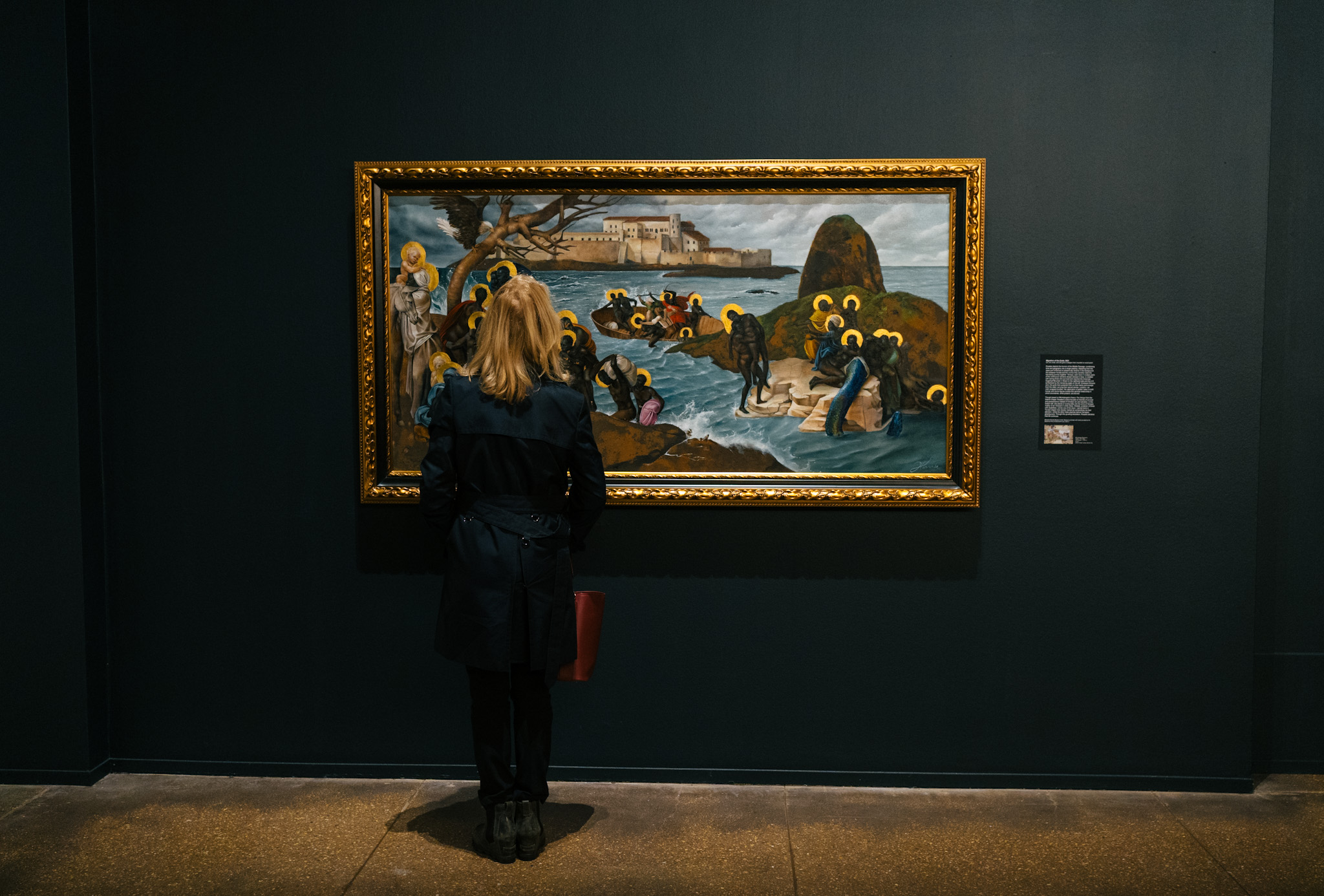
I’m also really proud of our Harmonia Rosales acquisition, Migration of the Gods (2021). This painting was showcased in my first major exhibition here and was also our first purchase through the Blackmon Perry Endowment Fund. It’s a powerful narrative of survival depicting the transatlantic slave trade that has particular resonance in a city like Memphis.
Where did your connection to art begin, and what keeps you inspired by it?
My mother influenced me early on. She’s a biochemist by trade but has always been very artistic. When I was growing up, we would sketch together, and she signed me up for art classes at the library on weekends. Even though I grew up in New Jersey and went into Manhattan every weekend, we never went to art museums. My earliest art experiences were actually in Washington, D.C., visiting extended family and going to the Smithsonian museums because they were free. I vividly remember walking through the National Gallery with my family and being most drawn to the gift shop.
When I went to UNC Chapel Hill, art history majors were required to take a studio art class. I joke that it was meant to humble you—it was one of the hardest classes I’ve ever taken. One project involved making a supersize version of my shoe out of clay. That sculpture is still in my parents’ basement, and it gave me a deep respect for artists. The creative pressure, deadlines, and vulnerability of turning ideas into a physical form take real courage.
Art creates a bridge between people and experiences—that’s what keeps me inspired. And having the freedom from my parents to pursue what I truly enjoyed was pivotal. I always remind young people entering the field: there’s no straight path.
Looking ahead, what gives you hope for museums and the arts?
Moments of change are challenging, but they also remind us why museums exist in the first place. They hold space for reflection, for dialogue, and for creativity, which are all things that become even more important during uncertain times.
Museums have weathered shifts before, and that history gives me confidence. Their relevance comes from the fact that they invite people to spark curiosity, think and feel deeply, and maybe even see the world differently. That’s powerful work, and it’s what keeps me inspired.
You’ve been here a decade now. What do you love most about Memphis?
I love the intense pride Memphians have for their city. It was one of the first things I noticed when I moved here. That careful equilibrium of the weight of history and the promise of a new day is constantly in flux and what makes this place sacred. People protect what they cherish, and ten years later, I understand why.
Just for fun—any surprising hobbies or facts we should know about you?
I love UNC basketball—Go Heels!—and I used to sing in a madrigal choir in high school in full Elizabethan costume. My hobbies include gardening, spending time with my family, playing tennis, and traveling to new places.