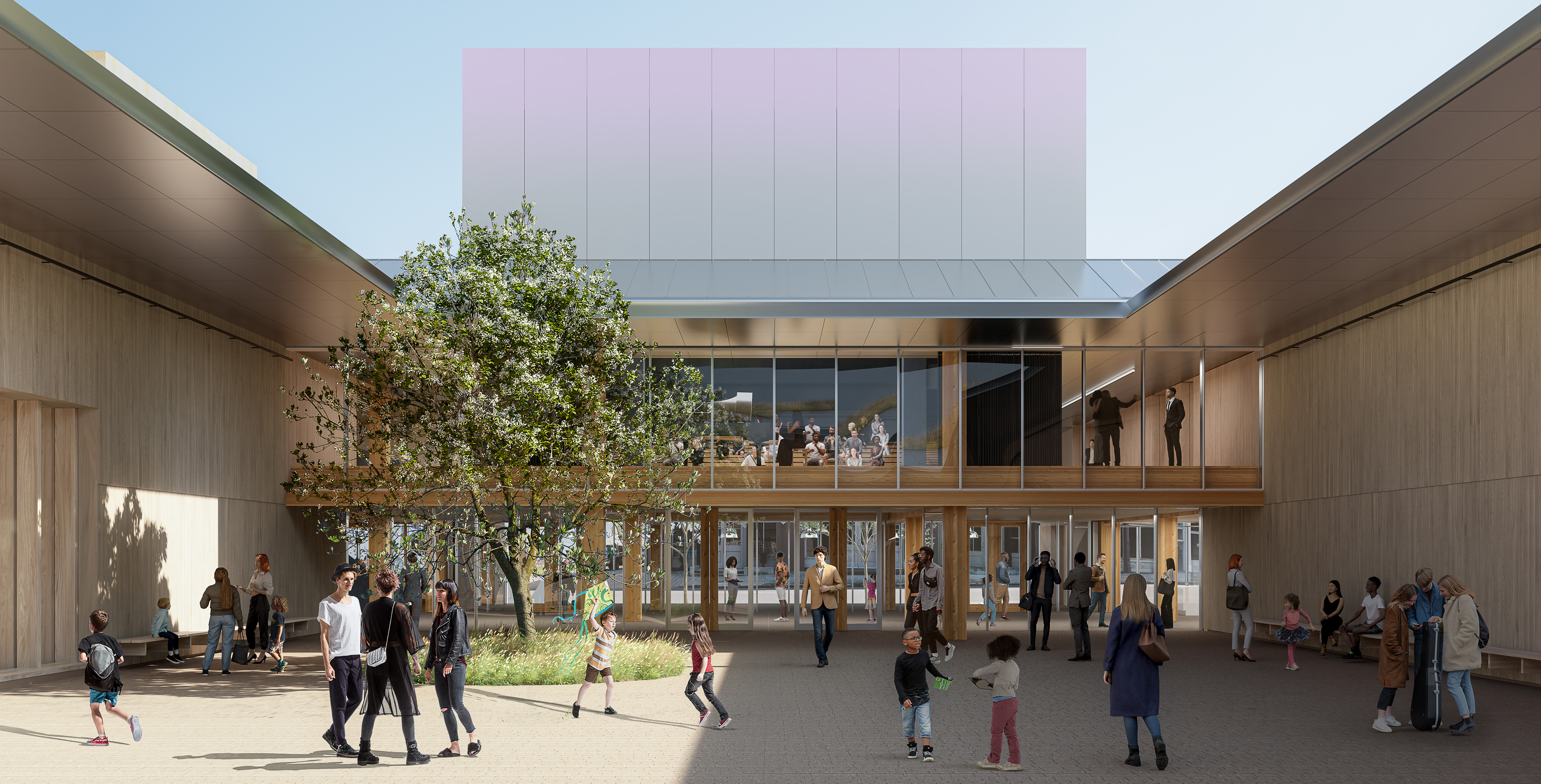

Memphis Art Museum to Open December 6, 2026 with Free Admission for All Shelby County Residents in Perpetuity
Museum’s New Community Courtyard to Be Named Hyde Square in Honor of Barbara and Pitt Hyde’s Enduring Investment in Memphis’s Cultural Landscape
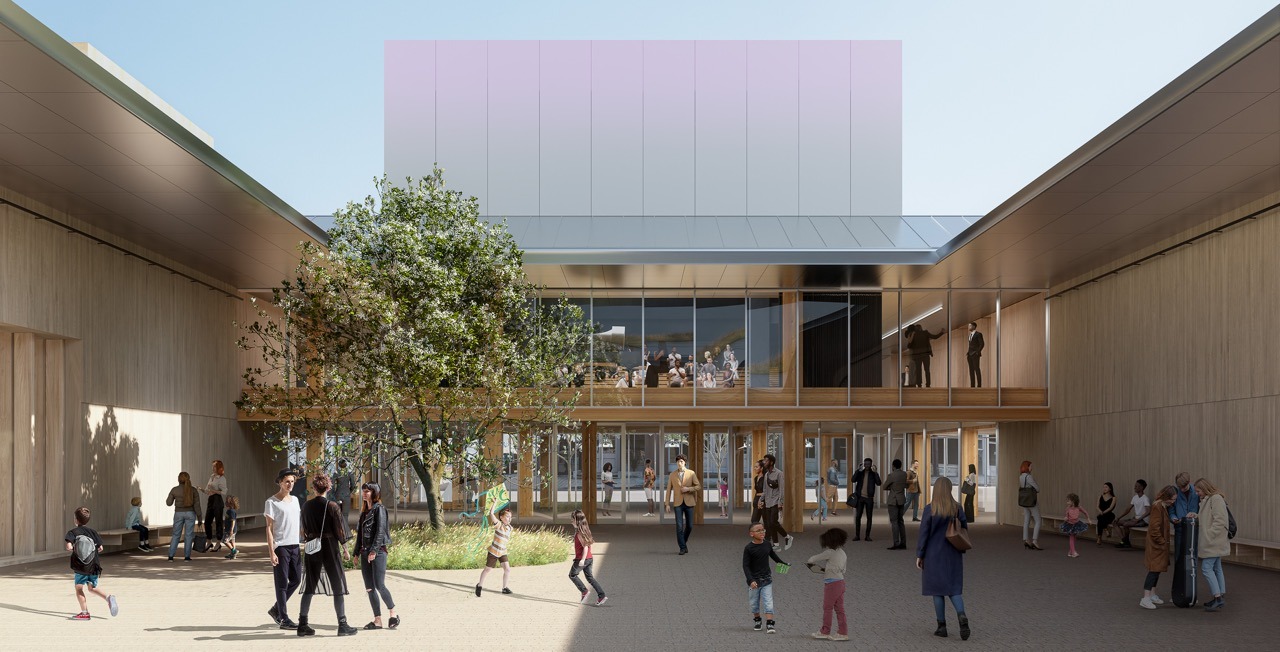
Hyde Square, named for philanthropists Barbara and Pitt Hyde, will be one of many free public spaces at Memphis Art Museum.
MEMPHIS, Tenn. (June 17, 2026) – Memphis Art Museum, alongside Mayor of Memphis Paul Young, today announced it will open its new 123,500-square-foot cultural campus to the public on December 6, 2026, and that museum admission will always be free for Shelby County residents.
“Memphis Art Museum brings the creativity and spirit of our city to a global audience, but it is rooted here in Memphis and belongs to the people of this city,” said Dr. Zoe Kahr, Executive Director. “Free admission is a permanent invitation to our Shelby County neighbors: this museum is yours. Visit often, bring those you love. Starting December 6, make this your place for inspiration, connection, and discovery.”
Shelby County, the most populous county in Tennessee, is home to over 900,000 people. Communities from every corner of the county will be welcomed to Memphis Art Museum free of charge, including Bartlett, Germantown, Lakeland, Millington, Arlington, Collierville and more. Free admission is made possible through the generosity of an anonymous donor who is a former “AutoZoner”. AutoZone and its employees are long-standing supporters of the museum.
"Culture is not something Memphis has. Culture is something Memphis is. And when our culture rises, Memphis rises with it," said Mayor Paul Young. "Memphis Art Museum being free for every Memphian, forever, isn't just a gift–it's an invitation: to come in, to come back, and to come often."
The museum, designed by internationally acclaimed Herzog & de Meuron and local architect of record archimania, expands the institution’s current gallery space by 50 percent and provides 600 percent more art-filled free public space, including a 50,000-square-foot rooftop sculpture garden.
At the center of the campus is a new 10,000-square-foot community courtyard, which will be named Hyde Square in recognition of philanthropists Barbara and Pitt Hyde of the Hyde Family Foundation. At the heart of the building, the courtyard is designed as a primary gathering place for visitors, families, students, and neighbors. Hyde Square will serve as one of the museum’s primary free public spaces.
“Bringing this museum to life has required tremendous vision, determination, and belief in Memphis,” said Carl Person, Chair of the Board of Directors for Memphis Art Museum. “Barbara and Pitt Hyde have championed this museum not for recognition, but because they believe Memphis deserves something transformative. Naming Hyde Square in their honor recognizes their extraordinary civic leadership at the heart of the museum, where Memphians will come together, linger, and feel at home.”
Memphis Art Museum also announced its inaugural art program for the opening, a sweeping presentation that brings the museum’s extensive world art collection into fresh dialogue with Memphis, the region, and the world. Founded 110 years ago, the museum holds more than 10,000 works of art spanning 5,000 years of global history.
Works on view will highlight key strengths of the collection, including Old Master paintings, American art of the late 19th and 20th centuries, contemporary art, and photography. These works will be presented alongside transformative recent acquisitions, including works of contemporary African American and African diasporic art, decorative arts and Asian art. These additions continue to expand the collection’s breadth, further strengthening its position as the largest collection of world art in the three-state region.
The museum’s primary opening exhibition will be Making Beauty: Hooks Brothers Studio, 1907–1984, a major survey of Memphis’s renowned Hooks Brothers Studio, featuring over 150 photographs. The exhibition centers on the studio’s philosophy of "making beauty" as an act of Black resistance and pride during the Jim Crow era and beyond. Working as artists and visual activists, the Hooks Brothers used their practice to document the extraordinary and everyday aspects of Black life and culture in the urban South. Presented in partnership with the National Civil Rights Museum, the exhibition positions the studio’s robust archive within the global history of photography, in dialogue with contemporaries such as Harlem Renaissance photographer James Van Der Zee.
Beyond the primary exhibition, 30,000 square feet of gallery space will be devoted to 19 “short stories,” focused presentations drawn from the best of the museum’s collection that bring works of art into conversation around shared themes, histories, materials, and ideas. Instead of arranging the collection in a traditional geographic or chronological sequence, the inaugural presentation responds to the architecture of the new building: a single-story loop of galleries encircling an interior courtyard, with multiple entry points and five galleries opening to views of the Mississippi River and Hyde Square. This layout allows works of art to speak both within individual galleries and across the building.
“Museums are storytellers,” said Dr. Patricia Lee Daigle, Chief Curator, Memphis Art Museum. “And the stories they tell often extend far beyond a single gallery. A theme may emerge in one space and reappear several galleries later. A work of art may create a bridge between two ideas. Even a glance across the courtyard can reveal an unexpected narrative.”
Together, the inaugural art program reflects the museum’s ambition to present a global collection in a way that remains unmistakably grounded in Memphis. The building’s openness, regionally-sourced materials, daylight, and views of the city and river help orient visitors to place, while the galleries invite them to make their own connections among works created across centuries and continents.
A selection of concepts in the museum’s inaugural program includes:
- Speaking in Shapes: A focused look at geometric abstraction and its power as a universal visual language. Often seen as precise, detached, and free of personal expression, geometry has long been utilized by artists to make viewers think and feel in profound ways. Works in the exhibition, including selections by Samuel Levi-Jones, Elizabeth Murray, and Dyani White Hawk, are in conversation with one another, crossing time and place, and highlighting the desire for artists to communicate in the most fundamental of forms.
- Medieval Bodies: An exploration of how artists in late medieval and early Renaissance Europe used the human body to make questions of faith, identity, illness, mortality, and the afterlife vivid and personal. Featuring works by artists such as Giovanni del Biondo, Taddeo di Bartolo, and Adriaen Isenbrandt, created from roughly 1000 to 1550 across Europe, the installation looks beyond biblical illustration to consider how religious art shaped social roles, stirred empathy, and helped viewers understand their own bodies and souls. Though made in a distant time and place, these works speak to enduring human concerns: relationships, fear of disease, belonging, suffering, and the mysteries of life and death.
- Rhapsodies in Black: An immersive exhibition exploring the profound influence of jazz—particularly free jazz—on Black American abstraction from the 1970s to the present. Featuring works by Sam Gilliam and Radcliffe Bailey alongside leading contemporary artists like Torkwase Dyson and James Little, the exhibition draws on rhythmic lines and expressive abstraction to evoke the genre’s spiritual depth and liberatory potential. A curated soundtrack of jazz legends further animates the gallery, referencing the dynamic interplay between visual art and musical innovation.
- An Inner Vision: Selections from the Hyde Collection: Highlighting four decades of collecting by Pitt and Barbara Hyde, this exhibition traces the collection’s origins in early formative years of American abstraction from works by Georgia O’Keeffe to global contemporary figures such as Pacita Abad,Cecily Brown, and Arthur Dove as well as other celebrated artists such as Stuart Davis, Marsden Harley, and Joan Mitchell. The show illustrates the Hydes' distinctive vision as collectors, charting a trajectory from the nature-focused modernism of the Stieglitz circle to the expressive, large-scale works of the contemporary international avant-garde.
- The River Calling: Storytelling in Memphis and the Mississippi Delta: An exploration of the region's unique visual language, this presentation features artists with deep ties to the Delta whose work navigates the complexities of Southern folklore, music, and history, including Frederick J. Brown, Carroll Cloar, William Eggleston, Ahmad George, and Carl E. Moore. It considers how oral traditions and regional dialects are translated into visual forms, revealing how absence and omission within storytelling can be as revealing and consequential as what is made visible.
- Head to the Sky: Taking its title from the 1991 Sounds of Blackness song “Optimistic,” Head to the Sky explores the fullness of Black American life by balancing historical struggles with vital moments of joy, leisure, and labor. Through a diverse range of eras and visual expressions—spanning from Civil Rights documentation to intimate family vignettes—this exhibition highlights the complexity of the Black experience as an invitation for optimism despite the heaviness of the world. Among the artists whose works will be on view are Derek Fordjour, Vanessa German, Titus Kaphar and Jordan Casteel, and Nelson Stevens.
The opening programming will also feature commissioned works by artists Jordan Ann Craig, Yunhee Min, Carlos Rosales Silva, and Memphis-based graphic designer Eso Tolson, installed in indoor and outdoor locations across the new cultural campus. Further details about the commissions will be announced at a later date.
About Memphis Art Museum
Opening on December 6, 2026 along the Mississippi River, Memphis Art Museum ushers in a new era for art, culture, and civic life in Memphis. As the reimagined home of the Memphis Brooks Museum of Art, the 123,500-square-foot cultural campus expands access to exhibitions, abundant public spaces, and new studios for learning and creativity while establishing a dynamic new landmark on the riverfront.
Designed as an open and welcoming destination for all, the museum features world-class architecture, expansive galleries, a rooftop sculpture garden, and year-round cultural programming. More than a museum, it is a place where creativity and shared experiences bring people together, inviting Memphians and visitors alike to engage with the transformative power of art.
Memphis Art Museum is one of the leading art museums in the American South. Its collection of more than 10,000 works spans five millennia and six continents, including ancient works from Greece, Rome, and the Ancient Americas; Renaissance masterpieces from Italy; English portraiture; American painting and decorative arts; contemporary art; and African Diasporic art. For more information visit brooksmuseum.org.
Media Contacts
Kelly Helton, Memphis Art Museum
kelly.helton@memphisartmuseum.org | 901-590-6935
Alli Steinberg, Polskin Arts
alli.steinberg@finnpartners.com | 212-583-2754
For full press release, please refer to the downloadable PDF.